On this page
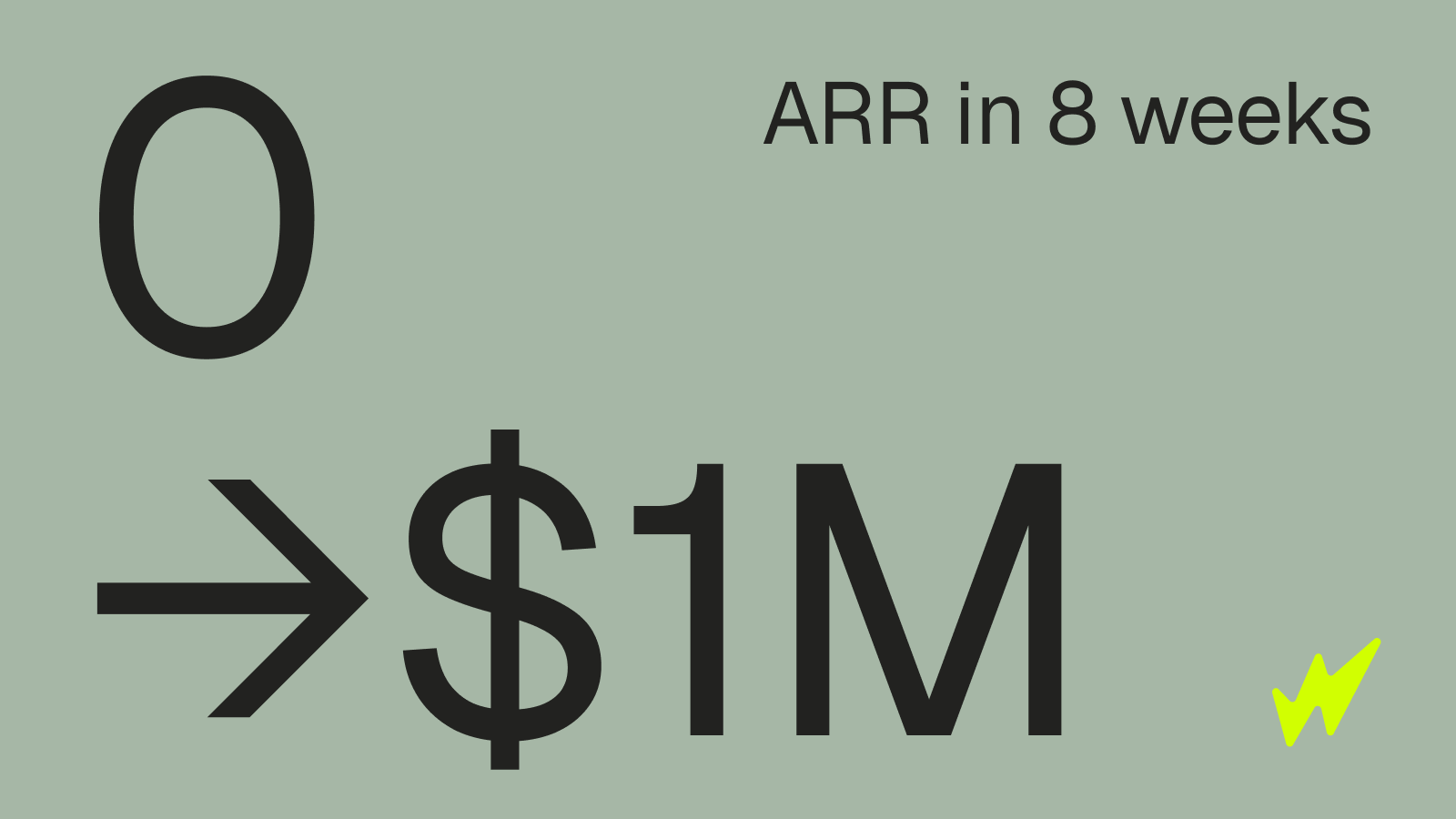
Eight weeks ago, Watt launched in beta. This week, we crossed $1M in annual recurring revenue.
Very few B2B companies in history have moved from zero to seven figures this fast. We share the number not as a flex, but because it's the clearest signal we have that the problem Watt is solving is more urgent and more universal than even we understood when we set out to build it.
This post is partly a thank you to the customers who got us here. Mostly, it's an attempt to articulate what these eight weeks have taught us about where AI is actually going.
What the milestone actually means
The $1M number is the easy headline. The real story is who's behind it.
Watt's customers are AI-native companies building agents that have to make consequential decisions about people and companies they've never seen before. Who to target. Who to approve. How to price. Whether to flag. They came to Watt because their agents were brilliant in demo and somehow still wrong in production. The reason was almost always the same: the data layer underneath the agent was built for a different era.
Four things we believe more strongly today than we did at launch
1. Agents need a data layer that was actually built for them.
Every existing data infrastructure on the market was designed for humans querying dashboards. APIs that retrieve fixed records. Schemas that assume someone in a meeting decided in advance what questions would matter. That model breaks the moment you put an AI agent in the seat. Agents don't query, they reason. They don't ask the questions you predicted, they ask the ones the situation demands. The data layer underneath them has to be built around that reality. Almost nothing on the market is.
2. Signal density changes the product, not just the performance.
When you give an agent 100,000+ real-world signals across 15 trillion data points and let it reason across them in real time, the result isn't a better version of the previous product. It's a different product entirely. Customers describe it the same way every time: "the agent finally feels like it knows what it's doing." That sentence keeps showing up unprompted. We think it's pointing at something foundational.
3. The craft is shifting.
For twenty years, getting valuable data inside a company meant waiting in line behind procurement, data engineering, platform, data science, and analytics. Five roles to surface a single insight. The best operators we work with are no longer waiting in line. They're composing directly against the reasoning graph, asking questions in plain language, and building agents that ship results their competitors can't. We've started calling this "signal engineering". The shift is real, it's accelerating, and the people on the front of it are pulling away from the rest.
4. The legacy stack is structurally cornered.
The incumbents in this space aren't standing still because they're complacent. They're standing still because their pricing models, data architectures, and customer contracts were all designed for a pre-AI world. Retrofitting a legacy data product for AI agents is like retrofitting a horse for a highway. They can't catch up without breaking their existing business. Eight weeks of customer conversations have made this clearer than any analyst report could.
What's next
This is the smallest Watt will ever be.
What we've shipped so far is the foundation. The next layers of the platform are already in motion, and a lot of what we're working on now will make today's product look like an early sketch. We're hiring across data platform engineering, forward-deployed engineering, and go-to-market. If you want to help build the data infrastructure layer for the agentic era, come find us.
To the customers who got us here: thank you. You took a bet on a beta product because you understood what we were building before most of the market had the words for it. We're going to keep earning that trust, and we're going to keep shipping.
To everyone else: the agentic era needs a data layer. We're building it. Come along.